Running an Interactive Activation in a Convention Center Ballroom: What Turnkey Should Actually Mean
Turnkey gets used loosely in this industry. Here is what it should actually mean once you are inside the room.
September 3, 2026 · 4 min read
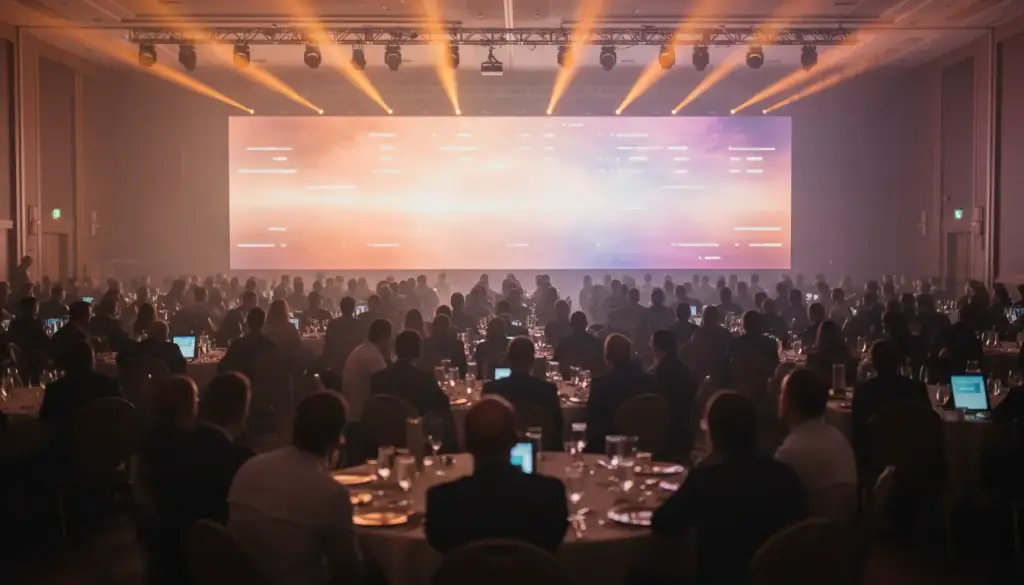
A resort ballroom and a convention center hall are not the same room, even when the floor plan on paper looks similar. One has fixed pillars, a lower ceiling, and a stage built into the architecture. The other is a raw box you build entirely from scratch, with sightlines that depend on wherever the drape and pipe happen to land that year. Planners who have run one interactive activation assume the next one will behave the same way. It rarely does, and that assumption is where most day-of surprises come from.
Sightlines come before theme
The first real question for any activation that depends on a shared screen or a leaderboard is not what the format looks like. It is whether every table can actually see it. A program built around touchscreen kiosks and a shared leaderboard, the way Day at the Derby® runs, only works if guests can track the board from wherever they are seated, not just from the tables closest to the stage. That means walking the room before the floor plan is finalized, not after, and pushing back on a layout that looks fine on a rendering but puts a third of the tables behind a pillar or a lighting truss.
Room shape also decides which format actually fits. A long, narrow resort ballroom with a low ceiling reads differently on a leaderboard than a wide, flat convention hall floor, and a program that offers more than one format, Horse Racing, Stock Market Mania®, Victory Lane®, The Main Event®, Armadillo Racing, or a custom-branded build, gives a planner room to match the theme to the actual architecture instead of forcing one format into every venue on the circuit. A boxing-style format built around predicting punches round by round plays differently on a wide screen at the end of a long room than a racing format built around a horizontal track graphic. Ask which format the crew has actually run in a room shaped like yours before you commit to one on a rendering alone.
Load-in windows are the real constraint
Convention centers and resort ballrooms both run tight load-in and load-out windows, often with several other events competing for the same loading dock and the same union labor call. A production that is genuinely portable and fast to install is not a marketing line, it is the difference between a program that is ready when doors open and one that is still being tested while guests are already finding their seats. Ask directly how long load-in takes for the guest count you are planning, and ask what happens if the load-in window gets compressed because the room turned late.
Coordinating audio around the rest of the night
Most evening programs are not standalone. There is a band or a DJ on the same agenda, and the interactive program has to share the room's sound system and its attention without stepping on either. That means race breaks and round announcements timed against the band's sets rather than running through them, and a single point of coordination on-site rather than two production teams guessing at each other's cues. This is exactly the kind of detail that separates a program built for one-off activations from one built specifically for the convention and resort circuit, where sharing a night with live music is the rule, not the exception.
What turnkey should actually mean
The word gets used loosely across this industry, so it is worth being specific about what it should cover once you are contracting for a real ballroom night.
- Staffing, equipment, and the presentation technology are provided and managed by the same team, not stitched together from subcontractors the week of the event
- The crew arrives with systems already tested rather than debugging kiosks in front of arriving guests
- The program is built to scale from a hundred guests to well over two thousand without changing vendors
- Someone on-site owns the schedule against the venue's actual load-in and turn times, not just the run-of-show on paper
Outrageous Adventures runs this model as a nationwide DMC-facing operation, with named coverage across convention destinations from Las Vegas and Orlando to Dallas's own Kay Bailey Hutchison Convention Center and beyond. That geographic range matters less for the theme of the program and more for the mundane part planners actually feel on-site: a crew that has already worked your specific venue, or one close enough to it, knows where the dock is, how long the elevator run takes, and what the house sound system can and cannot do. If your next program is in a ballroom you have never worked with this vendor before, ask about that venue history directly, and see the dmc-partners page for how the coast-to-coast coverage is structured.
Outrageous Adventures — 888-901-5166
Call 888-901-5166More articles
Why the Post-Dinner Slot Falls Flat, and What Actually Fixes It
It is not the band, the venue, or the crowd. It is the structure of the two hours you gave them.
Sponsor Visibility Without the Logo Wall: Making Brand Presence Feel Earned, Not Slapped On
A logo wall is decor. A branding wall guests actually want to be photographed in front of is something else entirely.